Cruce Saunders
  • Player card
  • Workshop
  • List
  • Contact

Research in London

Jun 2024Senate House, London

I started the study in my first weeks at Alpha, three months before London.

Cruce SaundersLevel 2
  • Player card
  • Workshop
  • List
  • Contact
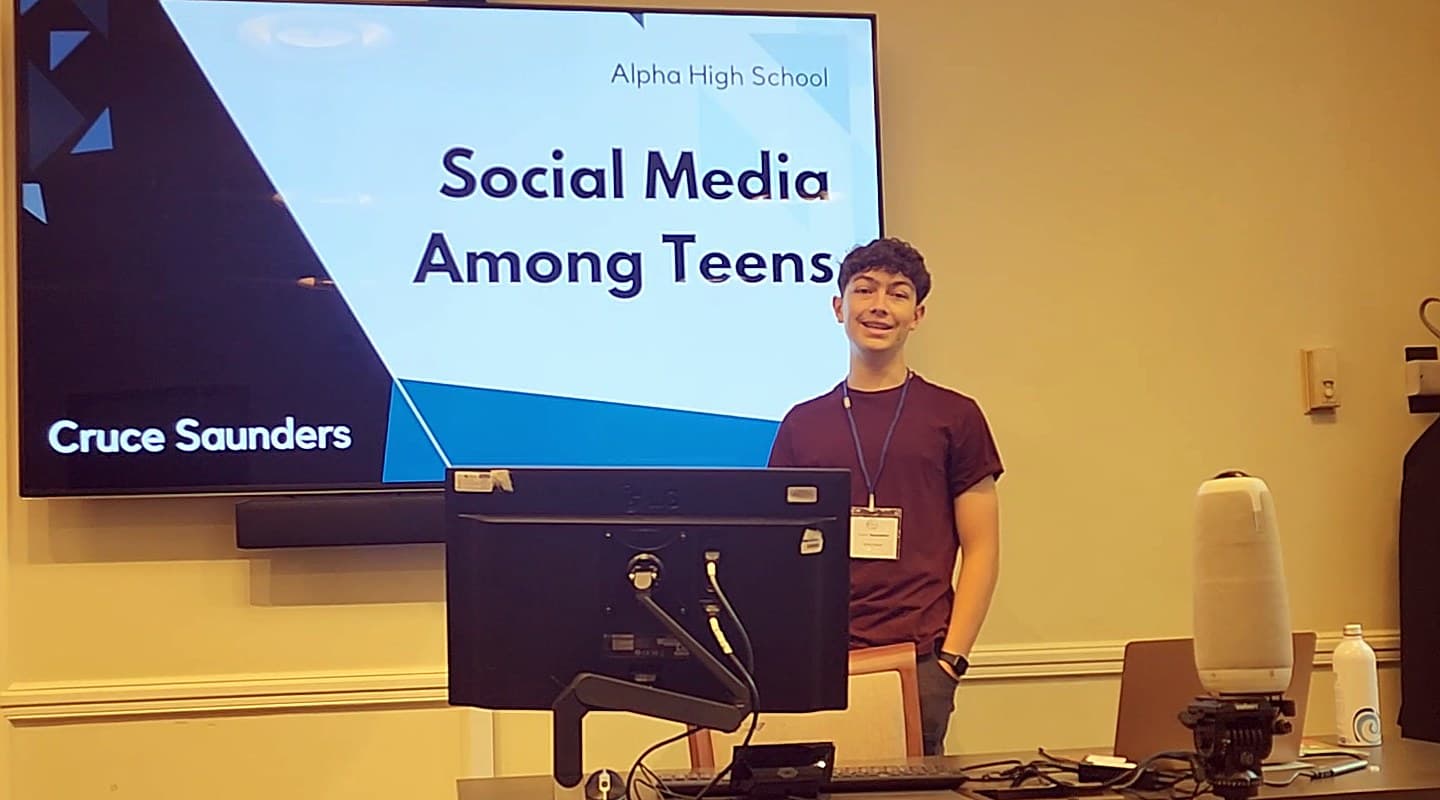
Cruce smiling beside his title slide, "Social Media Among Teens," at the Royal Anthropological Institute's conference in London.

Research in London

Researcher and speaker

Jun 2024Senate House, London

Back to the worldResearch in London
  • Player card
  • Workshop
  • List
  • Contact
  • Back to the world
  • Player card
  • Workshop
  • List
  • Contact

Research in London

In spring 2024 I ran an interview study on how Austin high schoolers live with social media.

I presented it at the Royal Anthropological Institute's 2024 conference at Senate House, University of London.

Its findings led to my first startup, LimitlessMinutes, and later to Crawft.

average drop in my testers' screen time
48%48%

I studied the habit I was breaking

When I got to Alpha, I was still climbing out of my own screen habit. In middle school I'd spend four or five hours a night on video games and YouTube, then drag myself through the next day. So when Alpha put me in an applied-anthropology workshop led by Chelsea King of the University of North Texas, I chose that habit as my subject.

My research question: “What values, beliefs, and behaviors are associated with social media use among high school students in Austin, Texas?” That April I also gave my first research talk at school, “The Hidden Impact of Digital Technology on Our Brains.”

I learned to do fieldwork

Over the next ten weeks I learned to run a study the way anthropologists do. I wrote an interview guide, sat down one on one with high schoolers across Austin, and pulled out the themes that kept coming up. Chelsea held me to a high bar: every claim had to be backed by what students actually said, and the talk had to be “a representation of THEIR voice.” I rewrote it until my interviewees' own words carried it.

AquestionWhat doAustinteensvalue,believe anddo aroundsocialmedia?Interv-iewsOne onone withhighschoolersacrossAustinFindingsMostadmittedaddiction,few cared,none couldname a goalTheLondontalkRoyalAnthropolo-gicalInstitute,Jun 25,2024Limitle-ssMinut-esAn appbuilt onwhat Ifoundinterview guiderecurring themesA questionWhat do Austin teens value, believe and doaround social media?InterviewsOne on one with high schoolers acrossAustinFindingsMost admitted addiction, few cared, nonecould name a goalThe LondontalkRoyalAnthropologicalInstitute, Jun 25,2024LimitlessMinu-tesAn app built onwhat I foundinterview guiderecurring themes
From one question to an international talk and a startup in about three months.DataPersonOutputSystem
  • A question: What do Austin teens value, believe and do around social media?
  • Interviews: One on one with high schoolers across Austin
  • Findings: Most admitted addiction, few cared, none could name a goal
  • The London talk: Royal Anthropological Institute, Jun 25, 2024
  • LimitlessMinutes: An app built on what I found
  • A question to Interviews: interview guide
  • Interviews to Findings: recurring themes
  • Findings to The London talk
  • Findings to LimitlessMinutes

No one I interviewed could name a goal

The students defined social media addiction as “an inability to put their phone down.” Most admitted they had it, and almost none cared. Boredom set off the scrolling. “It's like a bag of chips,” one told me. “The more you eat, the more you want.” Every student described a time they'd scrolled for four hours straight; one averaged nine hours a day while he was sick with mono.

The sharpest finding went on my slide plainly: when I asked about the future, no one could tell me a specific personal goal.

From the talk, June 25, 2024.

I presented it at Senate House

On June 25, 2024, I presented the study at the Royal Anthropological Institute's “Anthropology and Education” conference, held at Senate House, University of London. Founded in 1871, the institute is the world's oldest scholarly association for anthropology, and Alpha ran a workshop there on research led by high school students. I was one of the students presenting.

I opened with a number: the average teenager spends 4.8 hours a day on social media. Then I told the room my own story, and let my interviewees speak through their words on the slides.

My talk at Senate House, June 25, 2024.

Three days in London

I flew to London with Alpha's research group for the conference. These are from the day of the talk and the day before it.

Walking the room through my findings.

1 of 3
Cruce in a maroon shirt and conference badge, presenting in front of a slide of his findings on students' personal goals.

Walking the room through my findings.

1 of 3

I turned the findings into my first startup

My interviewees knew scrolling was hurting them. Knowing just wasn't enough to make them stop. What might work was other people. So I started LimitlessMinutes, an app where friends hold each other accountable. My first pitch deck for it is dated April 2024, right in the middle of the interviews, so the research and the product grew up together.

You join a group with your friends. When you open TikTok, they get a notification telling them to bug you off it, and a leaderboard ranks who stays off social media longest.

You open TikTokYour group getspingedEvery friend in youraccountability groupFriends bug youto get offYou close theappLeaderboardRanks who stayed offsocial media longesttime off countsnext time you'retemptedYou open TikTokYour group gets pingedEvery friend in your accountabilitygroupFriends bug you to get offYou close the appLeaderboardRanks who stayed off social medialongesttime off countsnext time you'retempted
LimitlessMinutes turned peer pressure into a reason to put the phone down.PersonSystemOutputData
  • You open TikTok
  • Your group gets pinged: Every friend in your accountability group
  • Friends bug you to get off
  • You close the app
  • Leaderboard: Ranks who stayed off social media longest
  • You open TikTok to Your group gets pinged
  • Your group gets pinged to Friends bug you to get off
  • Friends bug you to get off to You close the app
  • You close the app to Leaderboard: time off counts
  • Leaderboard to You open TikTok: next time you're tempted

My testers cut their screen time nearly in half

I built a working version and put it in testers' hands. Their screen time dropped 48% on average, and it stayed down. I kept improving LimitlessMinutes into 2025. By then I'd outgrown it and wanted to stretch my skills on bigger ventures, so I moved on. The next one was Ippo, a game built around a habit I wanted to keep: running.

The question stayed with me

Near the end of the talk, I described the tool I wanted to build someday. Two years later, Crawft does a version of it for schools: a small agent records what students actually do on their Macs, and AI turns each day into a plain-English report for their teachers.

“I intend to design a solution that includes an educational component showing users the impacts of their addiction by tracking their daily habits and digital behaviors.”

From my London talk, June 2024
The institute's 2024 conference

Led to

  • Level 5Ippo2025–2026
  • Level 7CrawftMay 2026–now

Back to the world