Cruce Saunders
  • Player card
  • Workshop
  • List
  • Contact
Cruce Saunders
  • Player card
  • Workshop
  • List
  • Contact

Apex SAT

Sep–Oct 2026WebLive

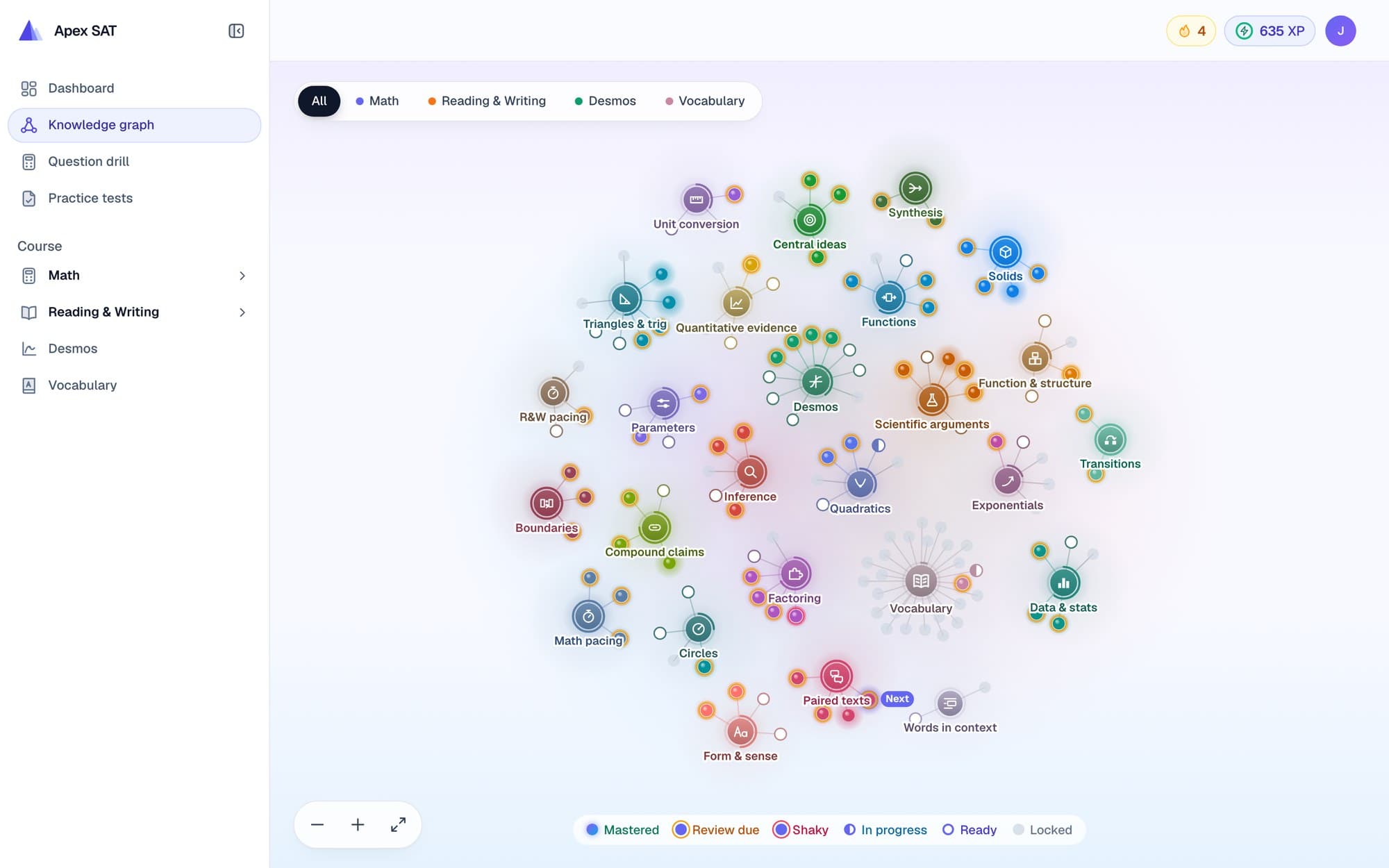
Apex SAT's knowledge graph: colored hubs for question types such as Quadratics, Inference and Circles, each ringed by small skill nodes, with a legend for mastered, review due, shaky, in progress, ready and locked. Sample progress.
Back to the worldApex SAT
  • Player card
  • Workshop
  • List
  • Contact
  • Back to the world
  • Player card
  • Workshop
  • List
  • Contact

Apex SAT

Apex SAT is a course I built for the hardest questions on the SAT, for students already scoring in the 1300s and 1400s who want the last 100 points.

It breaks those questions into 111 skills on a knowledge graph, drills each skill until you get three right in a row, schedules reviews the way Math Academy does, and runs full adaptive practice tests.

I built it in three days while studying for my own retake, with AI agents writing more than 12,000 practice questions and a second set of agents checking their answers.

skills on the knowledge graph
111111
practice questions
12,600+12,600+
SAT vocabulary words
1,0001,000
from first commit to live
3 days3 days

The last 100 points come from a few question types

The SAT is the college admissions test most US students take, scored from 400 to 1600. Past about 1400, the points you're missing come from a small set of hard question types near the end of each section. A week before Apex, I built SAT Study Desk and sorted the hardest questions from eight official practice tests by what they actually test. The pattern was clear: each hard type rests on a handful of specific skills, and missing any one of them sinks the question.

So Apex SAT is built as a knowledge graph. Each question type is a hub, its skills sit around it, and each skill is colored by where I stand: mastered, due for review, shaky, in progress, ready or locked.
A skill unlocks only when you're ready for it

The edges in the graph are prerequisites, and they're what make it a course instead of a question bank. A skill stays locked until everything under it is mastered, so you never drill something you can't do yet. Here is one real slice of the graph, the quadratics skills. Vertex form needs standard form. Finding where a parabola peaks needs both vertex form and factored form, and factored form reaches across into the factoring skills. Some links cross subjects entirely: completing the square for circle questions builds on vertex form.

Part of the graph: how the quadratics skills depend on each other

FactoringpatternsFrom the FactoringhubStandard formWhat a, b and ccontrolFactored formand zerosVertex formVertex locationMaximum and minimumheightSum and productof rootsCompleting thesquare forcirclesIn the Circles hubCoefficientshortcutsf(1), f(0), symmetryFactoringpatternsFrom the FactoringhubStandard formWhat a, b and ccontrolFactored formand zerosVertex formVertexlocationMaximum andminimum heightSum andproduct ofrootsCompleting the square for circlesIn the Circles hubCoefficient shortcutsf(1), f(0), symmetry
Each arrow points from a prerequisite to the skill it unlocks.DataOutput
  • Factoring patterns: From the Factoring hub
  • Standard form: What a, b and c control
  • Factored form and zeros
  • Vertex form
  • Vertex location: Maximum and minimum height
  • Sum and product of roots
  • Coefficient shortcuts: f(1), f(0), symmetry
  • Completing the square for circles: In the Circles hub
  • Factoring patterns to Factored form and zeros
  • Standard form to Vertex form
  • Vertex form to Vertex location
  • Factored form and zeros to Vertex location
  • Factored form and zeros to Sum and product of roots
  • Sum and product of roots to Coefficient shortcuts
  • Vertex location to Coefficient shortcuts
  • Vertex form to Completing the square for circles

Agents wrote the questions, and other agents checked them

A course like this lives or dies on its questions, and 111 skills need thousands of them. I set up a content pipeline that ran in parallel, one AI generator per question type, each writing SAT-style practice for its skills, mostly at the hard end. Then a separate verifier checked their work. For math it re-solved questions independently in Python and confirmed there was exactly one correct choice. For reading it checked that one answer, and only one, was defensible from the passage.

Figures were drawn in code rather than by an image model, because image models garble numbers and labels, and the verifiers rendered the figures to inspect them. Video scouts found a short clip for each skill and confirmed it could actually be embedded.

How the course content was made

87 real hard questionsFrom eight official practice testsQuestion types and 111skillsWith prerequisite linksGeneratorsOne per question type, in parallelVideo scoutsA short, embeddable clip per skillVerifiersRe-solve the math in Python, renderthe figuresThe course12,600+ questions, one graph87 real hard questionsFrom eight official practice testsQuestion types and 111 skillsWith prerequisite linksGeneratorsOne per questiontype, inparallelVideo scoutsA short,embeddable clipper skillVerifiersRe-solve the math in Python, renderthe figuresThe course12,600+ questions, one graph
DataAI agentOutput
  • 87 real hard questions: From eight official practice tests
  • Question types and 111 skills: With prerequisite links
  • Generators: One per question type, in parallel
  • Verifiers: Re-solve the math in Python, render the figures
  • Video scouts: A short, embeddable clip per skill
  • The course: 12,600+ questions, one graph
  • 87 real hard questions to Question types and 111 skills
  • Question types and 111 skills to Generators
  • Question types and 111 skills to Video scouts
  • Generators to Verifiers
  • Verifiers to The course
  • Video scouts to The course

Using it

Every session starts on the dashboard and ends in practice. This is what that looks like.

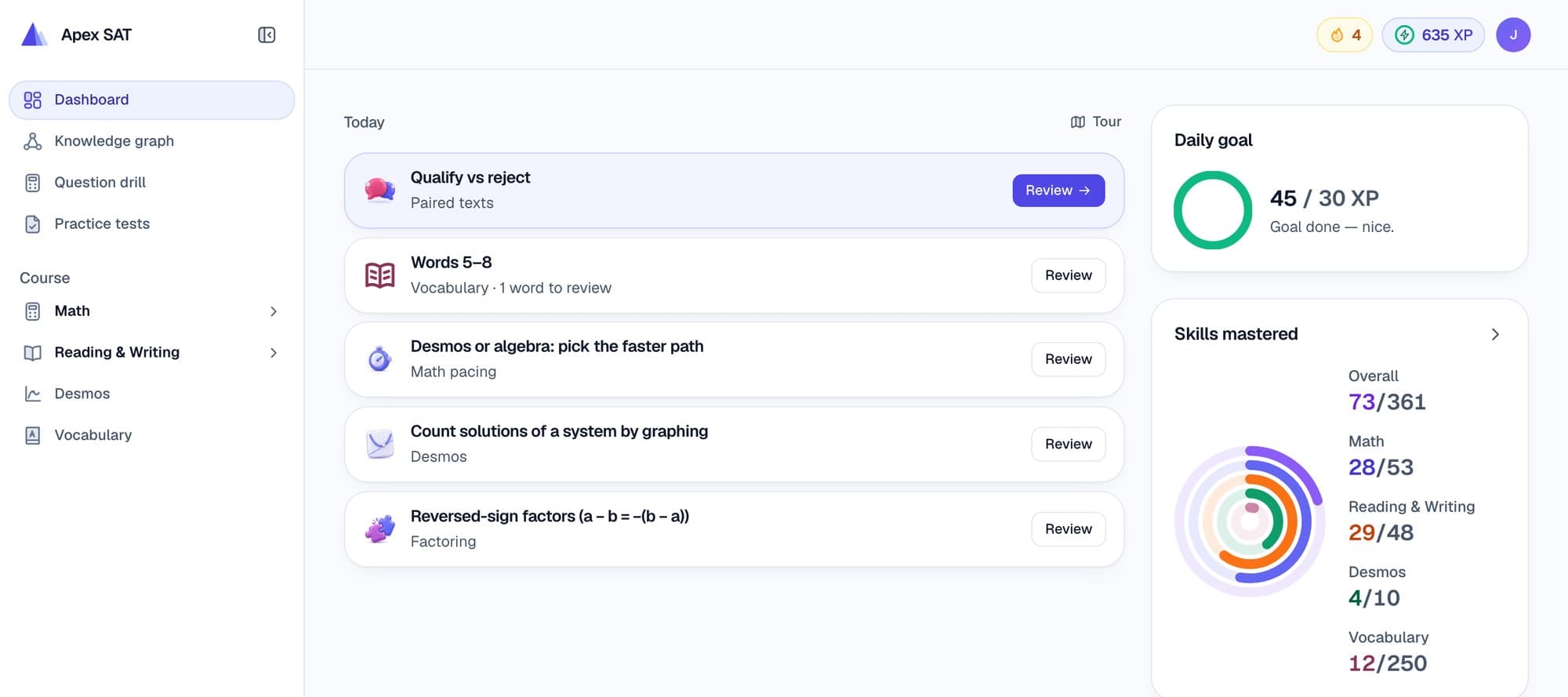
  1. The Apex SAT dashboard: a Today list of reviews in paired texts, vocabulary, math pacing, Desmos and factoring, a completed daily XP goal, and rings showing skills mastered by subject. Sample progress.
    1

    Step 1: The dashboard picks today's work

    The Today list has one job: tell me what to do next. It mixes new skills and reviews across subjects, so practice stays varied, and shows a daily XP goal and my streak. Rings track skills mastered in each subject.

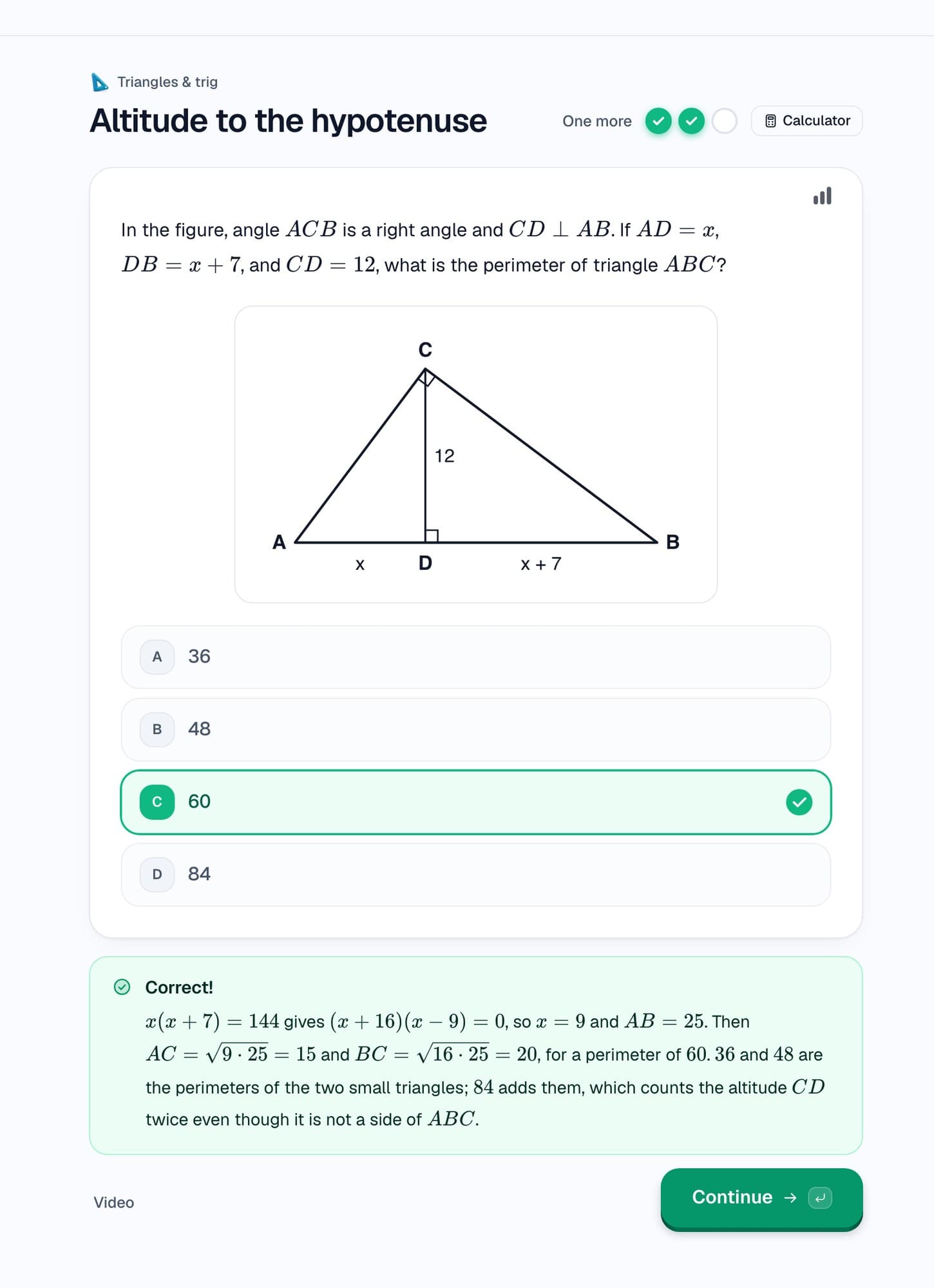
  2. An Apex SAT practice question on the altitude to the hypotenuse: a labeled right-triangle figure, choice C marked correct, a worked explanation below, and two of three streak dots filled.
    2

    Step 2: Practice ends at three in a row

    Each skill opens with an optional short video clip, then goes straight to hard practice, hardest questions first. Every answer shows the reasoning, including where the tempting wrong choices come from. Three dots track my streak; a miss resets it, and the skill counts as mastered only after three correct in a row.

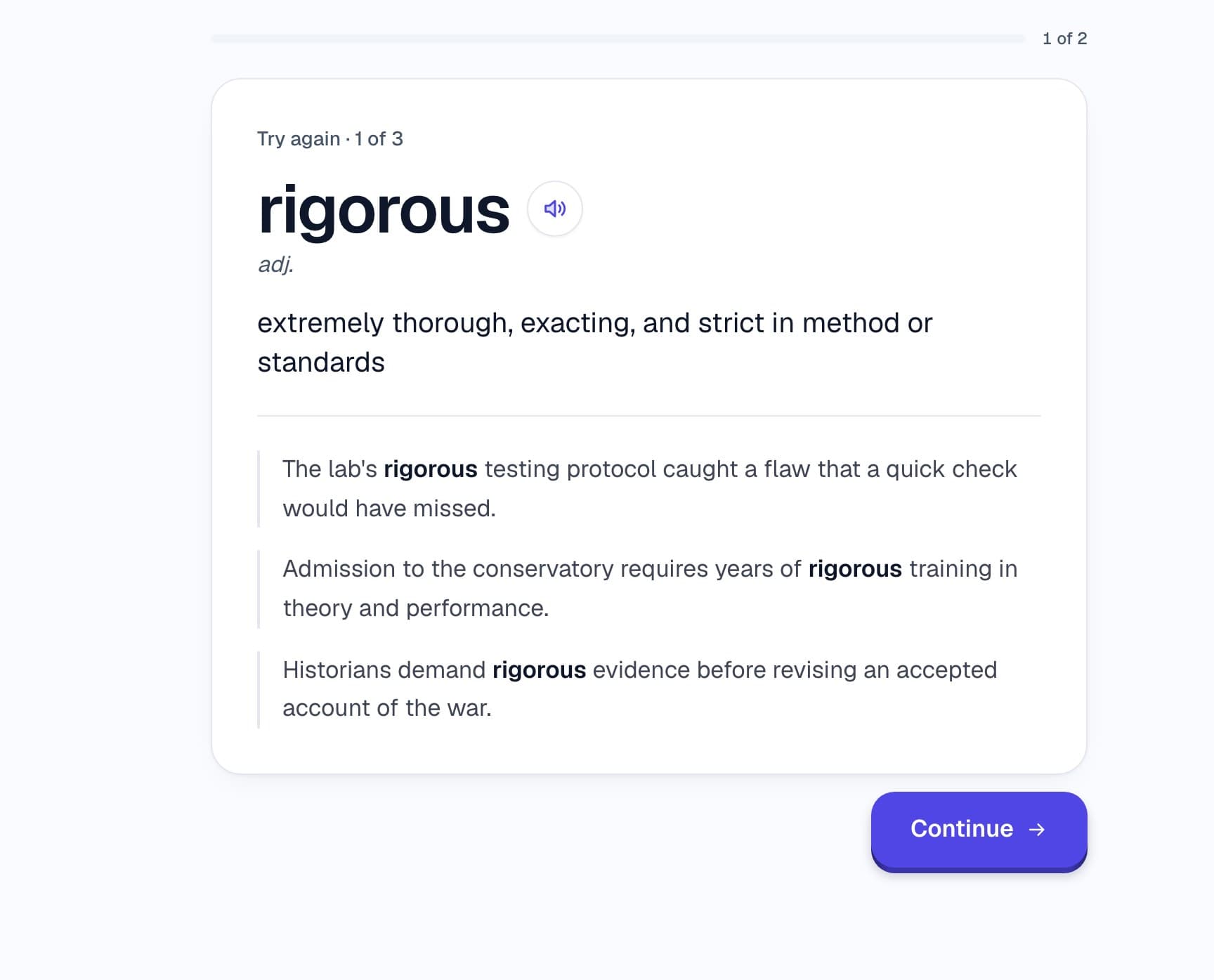
  3. An Apex SAT vocabulary card for 'rigorous': the adjective's definition, a pronunciation button and three example sentences, with a Continue button.
    3

    Step 3: Vocabulary in sets of four

    Vocabulary questions are free points if you know the word, so the course has 1,000 SAT words in 250 sets of four. Each card has a plain definition, three example sentences and a recorded pronunciation. Missed words come back until I get them.

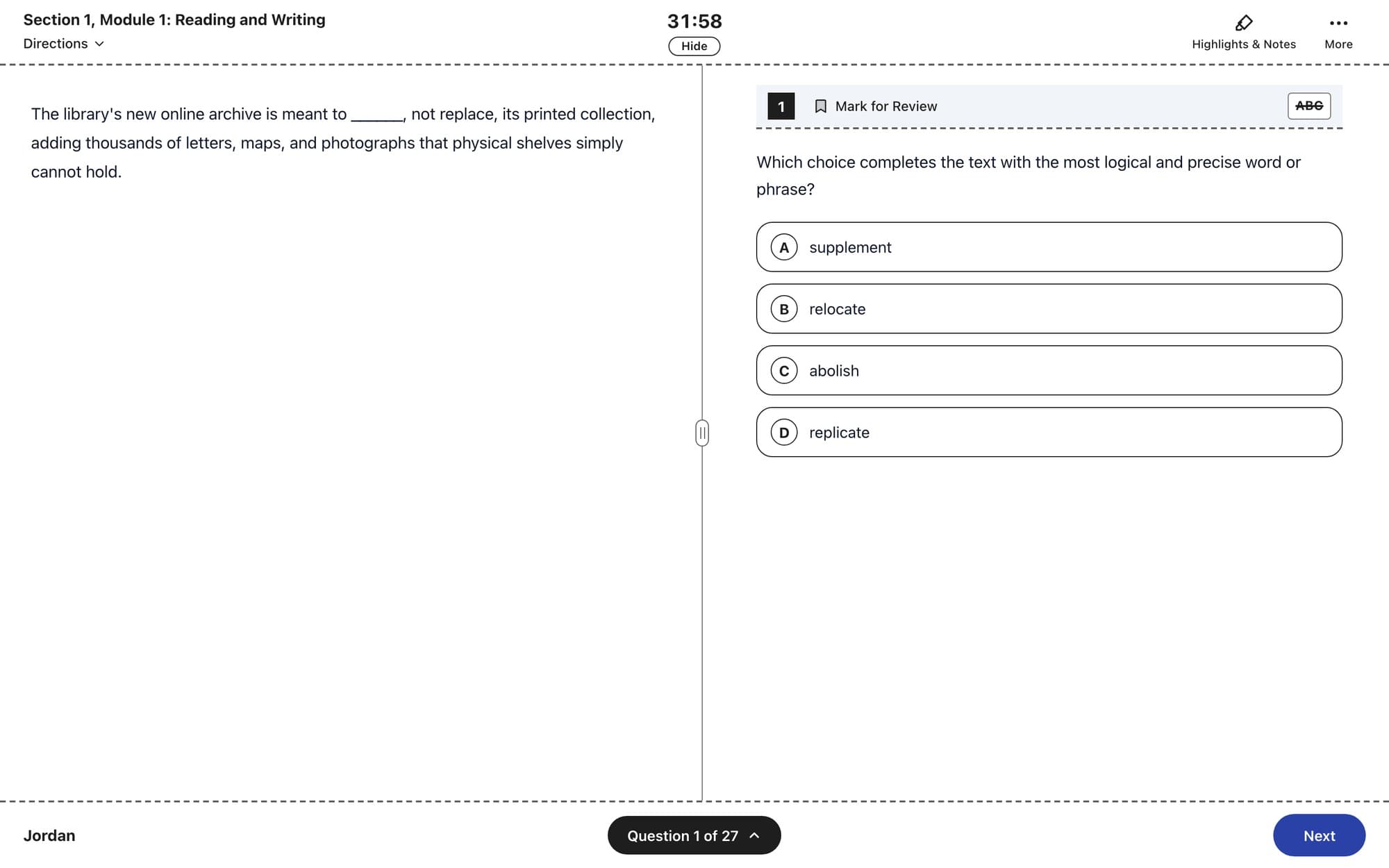
  4. The Apex SAT practice-test room: a fill-in-the-blank reading question on the left, four answer choices on the right, a 31:58 timer at the top and a question navigator at the bottom.
    4

    Step 4: Full tests in a test-day room

    Three full-length adaptive tests run in a room modeled on the digital SAT: passage on the left, question on the right, a countdown, mark-for-review and a question navigator. The server grades the first module and routes me to an easier or harder second one, like the real test, then estimates my score.

The Apex SAT dashboard: a Today list of reviews in paired texts, vocabulary, math pacing, Desmos and factoring, a completed daily XP goal, and rings showing skills mastered by subject. Sample progress.
An Apex SAT practice question on the altitude to the hypotenuse: a labeled right-triangle figure, choice C marked correct, a worked explanation below, and two of three streak dots filled.
An Apex SAT vocabulary card for 'rigorous': the adjective's definition, a pronunciation button and three example sentences, with a Continue button.
The Apex SAT practice-test room: a fill-in-the-blank reading question on the left, four answer choices on the right, a 31:58 timer at the top and a question navigator at the bottom.

Reviews follow Math Academy's model

Mastering a skill once isn't the same as keeping it until test day, so mastered skills come back for review on a schedule modeled on Math Academy's, a math program known for its spaced-repetition research. Each review you pass pushes the next one further out: one day, then about two, five, eleven and twenty-three. Because skills are linked, passing a harder skill also gives partial credit to the simpler skills inside it, so you aren't re-drilled on what you just proved. Failing a skill brings it straight back and moves up the reviews of the harder skills that depend on it. When several reviews are due, the dashboard picks the ones that cover the most others.

What happens after a skill is mastered

MasteredThree in a rowReview comes dueGaps grow: 1, 2, 5,11, 23 daysThree-questionreviewA fail brings itback todayPassPartial credit flowsto the simpler skillsinside ittwo of threenext gap is longerMasteredThree in a rowReview comes dueGaps grow: 1, 2, 5, 11, 23 daysThree-question reviewA fail brings it back todayPassPartial credit flows to the simplerskills inside ittwo of threenext gap is longer
OutputSystemPerson
  • Mastered: Three in a row
  • Review comes due: Gaps grow: 1, 2, 5, 11, 23 days
  • Three-question review: A fail brings it back today
  • Pass: Partial credit flows to the simpler skills inside it
  • Mastered to Review comes due
  • Review comes due to Three-question review
  • Three-question review to Pass: two of three
  • Pass to Mastered: next gap is longer

Watch it, then try it

I went from first commit to a live site in three days and 86 commits. A walkthrough of the course: the knowledge graph, a skill opened from it, a hard question answered with its explanation, and the dashboard's list for today.

Apex SAT in use, with sample progress.
Open Apex SAT

More builds

  • Mac appTaskGo!Feb–May 2026
  • HardwareDrum CockpitMay 2026

Back to the workshop