Cruce Saunders
  • Player card
  • Workshop
  • List
  • Contact
Cruce Saunders
  • Player card
  • Workshop
  • List
  • Contact

Opportunity Scout

May 2026WebPrototype

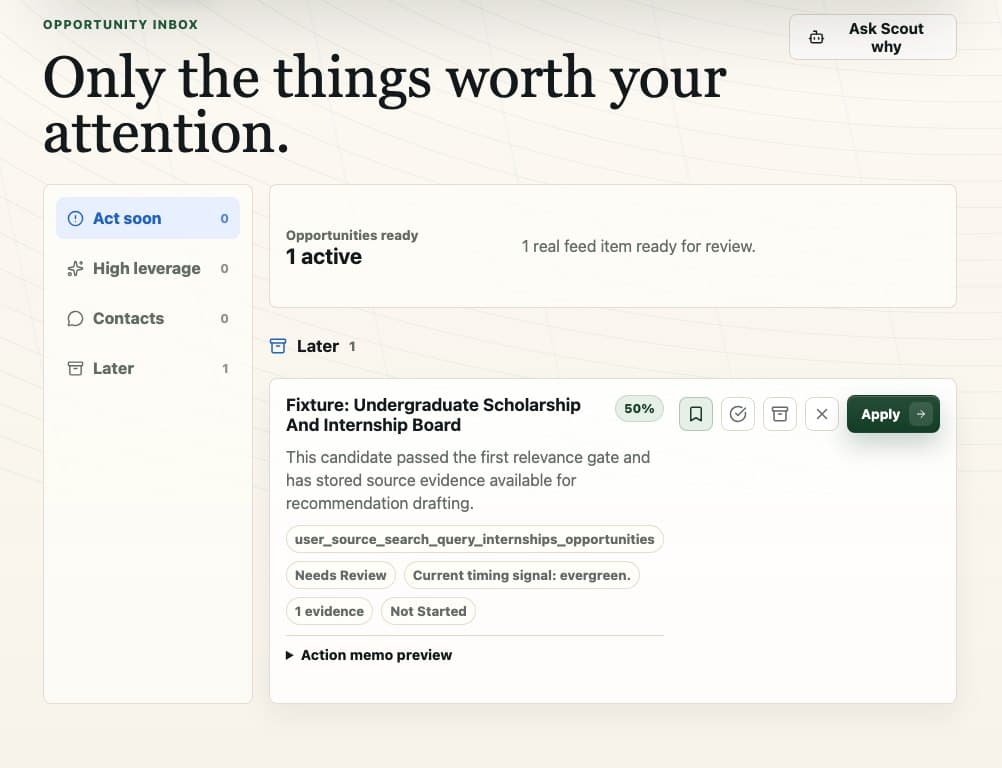
Opportunity Scout's inbox: the headline 'Only the things worth your attention,' lanes for Act soon, High leverage, Contacts and Later, and a scholarship card with a 50% relevance score and an Apply button.
A made-up test user: a student looking for scholarships and internships.
Back to the worldOpportunity Scout
  • Player card
  • Workshop
  • List
  • Contact
  • Back to the world
  • Player card
  • Workshop
  • List
  • Contact

Opportunity Scout

Opportunity Scout is an AI research team for one person: it learns who you are, then finds the grants, programs, competitions and contacts you would otherwise miss.

It turns your context into a profile, picks sources worth watching, scans them on a schedule, and only lets through the findings that clear its filters, each with why it matters and what to do.

I specced it as 24 systems and had 24 AI workers build them in parallel, and a week later I started Crawft the same way.

systems, one AI worker each
2424
rounds of testing
1313
made-up test users
1212

The best opportunities are the easiest to miss

The things that can change a year, like a grant, a fellowship, a pitch competition or the right introduction, are scattered across directories, newsletters, X threads and program pages. Most people hear about them after the deadline, and the people who don't usually have someone scanning for them. I wanted that someone for everyone: a founder looking for funding, a student hunting scholarships, a career switcher looking for a way in.

Opportunity Scout is that research team. You tell it about yourself once, and it does the watching. What reaches you is one inbox of findings sorted into Act soon, High leverage, Contacts and Later, each with a relevance score, the evidence behind it and a single next action.
Scout runs as a loop that learns

Behind the inbox, Scout works as a continuous loop. Your context becomes a structured profile, and the profile decides which sources are worth watching. A research swarm scans those sources on a schedule and stores everything it finds. Each raw finding is turned into a clean candidate, filtered against your profile, and then checked to make sure it's real, current and actionable before it becomes a recommendation. Urgent ones arrive as alerts; the rest wait in the feed. Everything you do with a finding, saving it, finishing it, dismissing it, feeds back into the profile and the sources, so the next scan aims better.

How Scout finds what matters to you

Your profileBuilt from yourgoals, projects andconstraintsSourcesChosen for you,graded by how muchthey yieldResearch swarmScans every source ona scheduleFilter andverifyRelevant to you?Real, current,actionable?RecommendationWhy it matters andwhat to doYour reactionsSave, done, dismissraw findingsonly what clears thebarsharper next timeYour profileBuilt from your goals, projects andconstraintsSourcesChosen for you, graded by how muchthey yieldResearch swarmScans every source on a scheduleFilter and verifyRelevant to you? Real, current,actionable?RecommendationWhy it matters and what to doYour reactionsSave, done, dismissraw findingsonly what clearsthe barsharper next time
DataAI agentSystemOutputPerson
  • Your profile: Built from your goals, projects and constraints
  • Sources: Chosen for you, graded by how much they yield
  • Research swarm: Scans every source on a schedule
  • Filter and verify: Relevant to you? Real, current, actionable?
  • Recommendation: Why it matters and what to do
  • Your reactions: Save, done, dismiss
  • Your profile to Sources
  • Sources to Research swarm
  • Research swarm to Filter and verify: raw findings
  • Filter and verify to Recommendation: only what clears the bar
  • Recommendation to Your reactions
  • Your reactions to Your profile: sharper next time

Using it

Scout is built so you give it context once and keep steering it after that.

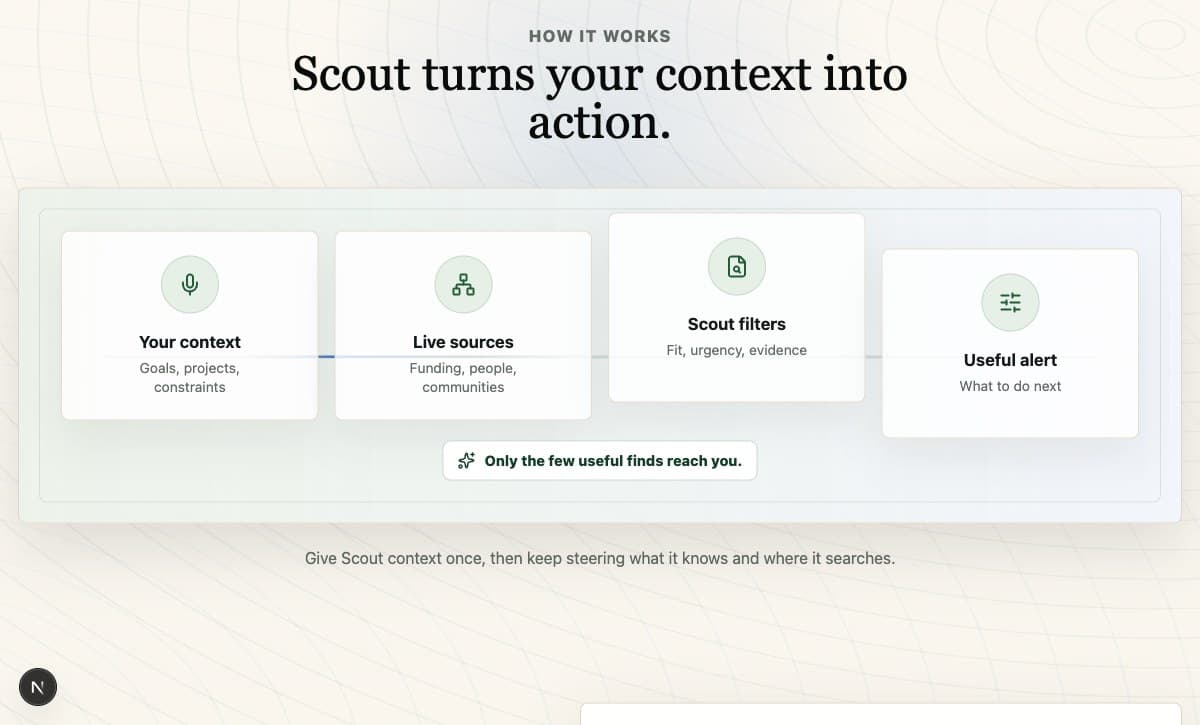
  1. Opportunity Scout's 'How it works' section: four cards for Your context, Live sources, Scout filters and Useful alert, joined by a line, above 'Only the few useful finds reach you.'
    1

    Step 1: Give it context once

    You describe your goals, projects and constraints. Scout matches them against live sources, from funding directories to communities, filters every find for fit, urgency and evidence, and turns the few that pass into alerts that say what to do next.

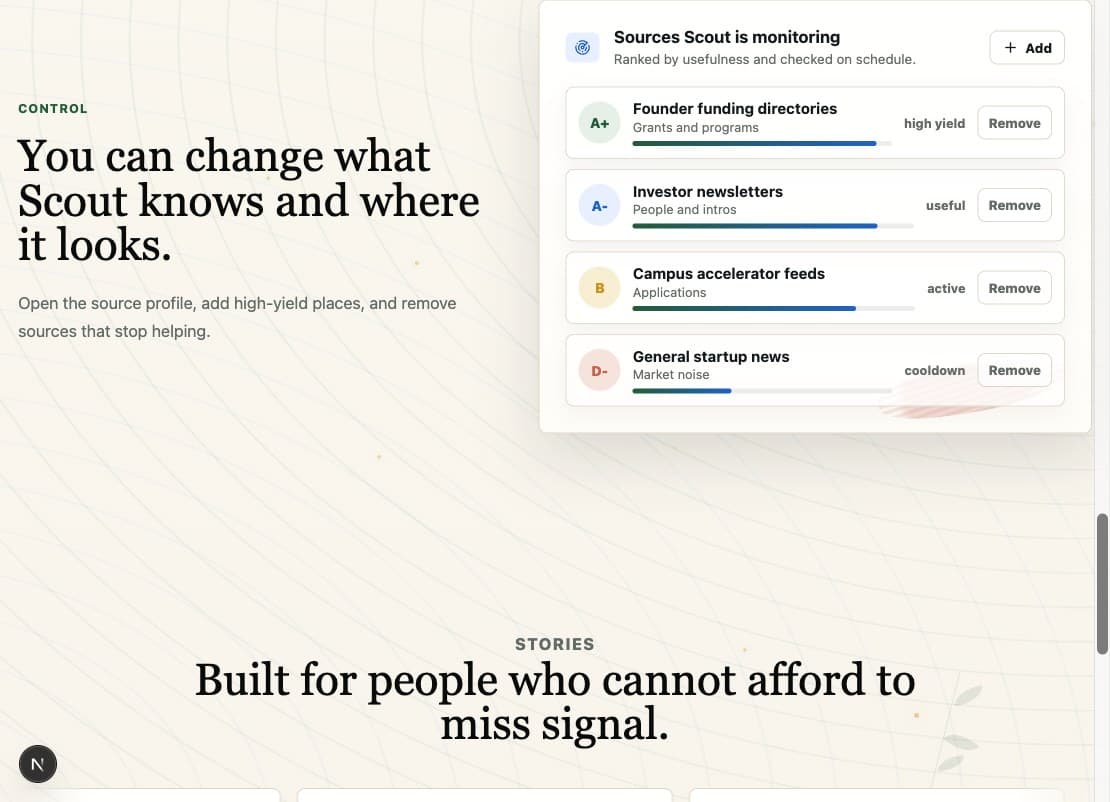
  2. Scout's source panel: founder funding directories graded A+ and high yield, investor newsletters A-, campus accelerator feeds B, and general startup news D- in cooldown, each with a Remove button.
    2

    Step 2: Steer where it looks

    Every source gets a grade based on how much it actually yields. You can add places you trust and remove ones that stop helping; a noisy source like general startup news drops to a cooldown on its own.

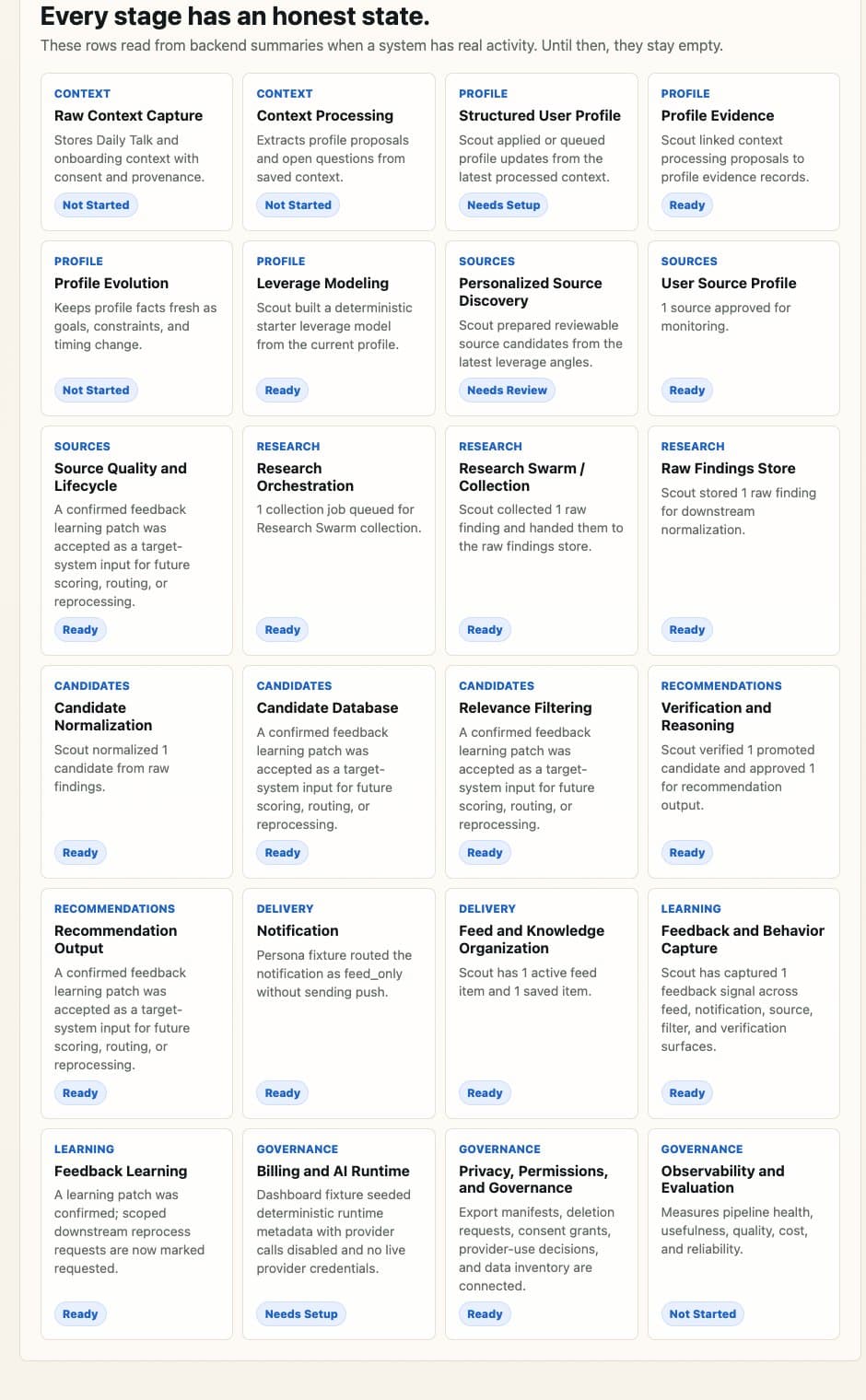
  3. The Systems page grid titled 'Every stage has an honest state': 24 cards from Raw Context Capture to Observability and Evaluation, each tagged Ready, Needs Setup, Needs Review or Not Started.
    3

    Step 3: Trace any recommendation back

    The Systems page shows every stage of the engine with an honest state: Ready, Needs Review, Needs Setup or Not Started. When a recommendation looks wrong, you can follow the run back to the stage that produced it, and Ask Scout why explains any card in plain words.

Opportunity Scout's 'How it works' section: four cards for Your context, Live sources, Scout filters and Useful alert, joined by a line, above 'Only the few useful finds reach you.'
Scout's source panel: founder funding directories graded A+ and high yield, investor newsletters A-, campus accelerator feeds B, and general startup news D- in cooldown, each with a Remove button.
The Systems page grid titled 'Every stage has an honest state': 24 cards from Raw Context Capture to Observability and Evaluation, each tagged Ready, Needs Setup, Needs Review or Not Started.

I wrote the product as 24 systems before any code

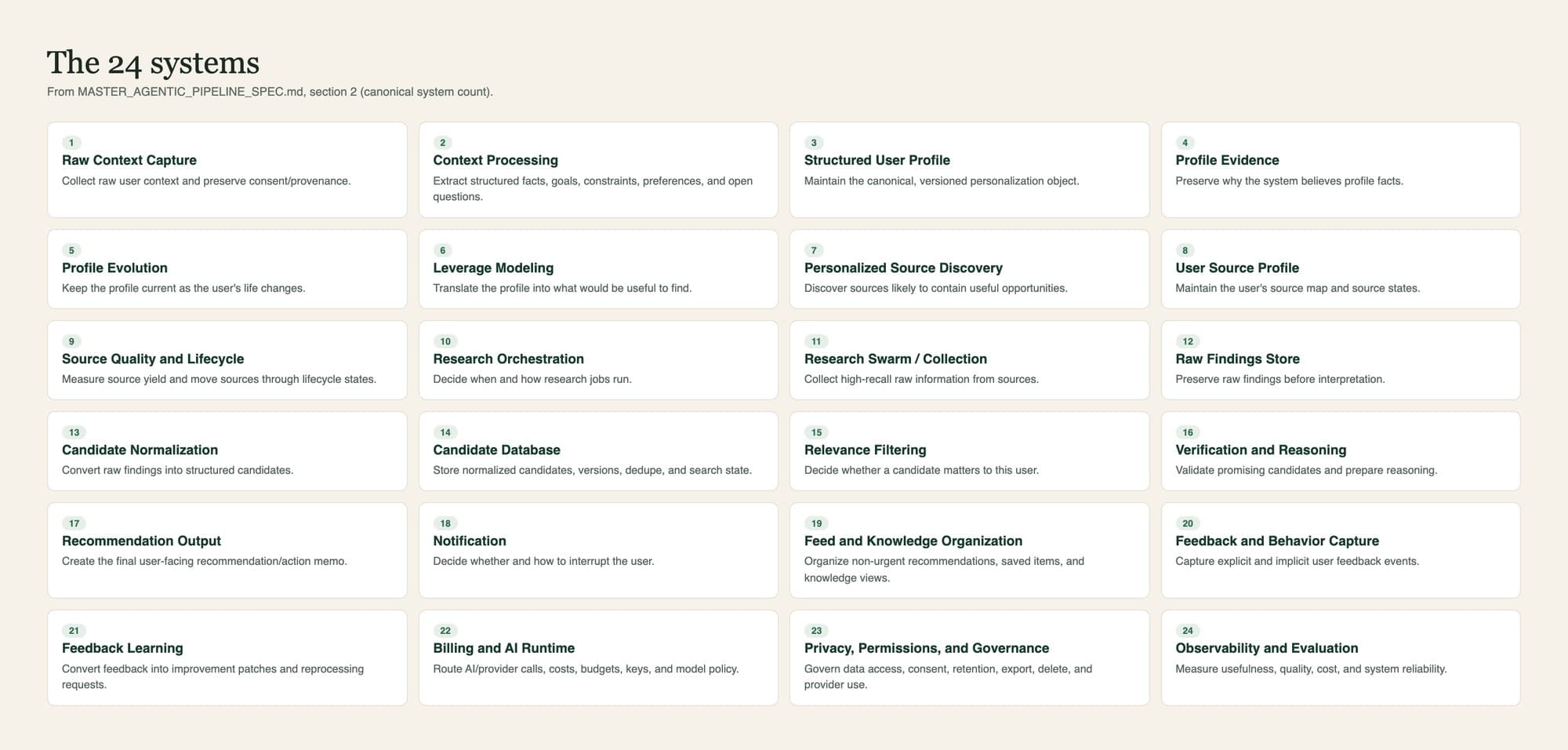
Scout has a lot of moving parts, and I knew a single AI session would lose the thread long before it finished. So I started with a written spec and broke the product into 24 numbered systems, each with its own job, inputs and outputs: raw context capture, profile building, source discovery, the research swarm, relevance filtering, verification, notifications, feedback learning, billing, privacy and more. A shared contract pinned down the routes and data shapes every system had to use, so 24 pieces built separately would still fit together.

A grid of Opportunity Scout's 24 numbered systems, each with a one-line job, from 1 Raw Context Capture and 10 Research Orchestration to 24 Observability and Evaluation.

Then 24 AI workers built it at once

On May 6 I launched 24 AI coding workers in parallel, one per system, each with its own brief and the shared contract. An orchestrator reviewed what each one returned, ran the tests and opened the next wave of fixes. Over the next week it ran 13 rounds of testing against a dozen made-up test users, from a student hunting scholarships to an indie game studio looking for funding, with an overnight watchdog checking progress every hour. The later rounds rendered every test user's pages in a real browser, so I could see whether the right finding reached the right person.

How Scout was built

The specOrchestrator24 AI workers, launched May 6TestingResultOvernight watchdogChecked the run's progress every hour while I slept.Spec andcontract24 numberedsystems, sharedroutes and datashapesOrchestratorWrote eachbrief, reviewedwhat came back,ran the testsOne worker per system, all at onceEach with its own brief and the shared contractRaw contextcaptureContextprocessingStructured userprofileProfile evidenceProfileevolutionLeveragemodelingSource discoveryUser sourceprofileSource qualityResearchorchestrationResearch swarmRaw findingsstoreCandidatenormalizationCandidatedatabaseRelevancefilteringVerificationRecommendationsNotificationsFeedorganizationFeedback captureFeedbacklearningBilling and AIruntimePrivacy andpermissionsObservability13 testrounds12 made-up testusers, everypage rendered ina real browserWorkingpipelineEvery stage withlogs and anhonest statecontract24briefscodepassesgaps become the next wave of fixesThe specOrchestrator24 AI workers, launched May 6TestingResultOvernight watchdogChecked the run's progress every hour while Islept.Spec and contract24 numbered systems, shared routes and datashapesOrchestratorWrote each brief, reviewed what came back,ran the testsOne worker per system, all at onceEach with its own brief and the sharedcontractRaw contextcaptureContext processingStructured userprofileProfile evidenceProfile evolutionLeverage modelingSource discoveryUser sourceprofileSource qualityResearchorchestrationResearch swarmRaw findings storeCandidatenormalizationCandidate databaseRelevancefilteringVerificationRecommendationsNotificationsFeed organizationFeedback captureFeedback learningBilling and AIruntimePrivacy andpermissionsObservability13 test rounds12 made-up test users, every page renderedin a real browserWorking pipelineEvery stage with logs and an honest statecontract24 briefscodepassesgaps become the next wave offixes
Every worker built against the same contract, so 24 pieces built separately still fit together.Request pathSent backOvernight watchdog
  • Spec and contract: 24 numbered systems, shared routes and data shapes
  • Orchestrator: Wrote each brief, reviewed what came back, ran the tests
  • One worker per system, all at once: Each with its own brief and the shared contract. Raw context capture; Context processing; Structured user profile; Profile evidence; Profile evolution; Leverage modeling; Source discovery; User source profile; Source quality; Research orchestration; Research swarm; Raw findings store; Candidate normalization; Candidate database; Relevance filtering; Verification; Recommendations; Notifications; Feed organization; Feedback capture; Feedback learning; Billing and AI runtime; Privacy and permissions; Observability
  • 13 test rounds: 12 made-up test users, every page rendered in a real browser
  • Working pipeline: Every stage with logs and an honest state
  • Overnight watchdog: Checked the run's progress every hour while I slept.
  • Overnight watchdog at Orchestrator
  • Overnight watchdog at One worker per system, all at once
  • Overnight watchdog at 13 test rounds
  • Spec and contract to Orchestrator: contract
  • Orchestrator to One worker per system, all at once: 24 briefs
  • One worker per system, all at once to 13 test rounds: code
  • 13 test rounds to Working pipeline: passes
  • 13 test rounds to Orchestrator (sent back): gaps become the next wave of fixes

Six of the twelve test users, each with a different top finding.

1 of 1
Six inbox screenshots from the QA rounds, one per test persona, each with a different top finding: a scholarship board, a game showcase grant, a climate grant, a food market pop-up, a STEM classroom grant and a foundation grant call.

Six of the twelve test users, each with a different top finding.

1 of 1

The method went straight into Crawft

Scout proved something bigger than Scout: one person with a clear spec can run two dozen AI workers on one product at once and still end up with a coherent system. On May 14 I paused Scout, and on May 21 I opened the conversation that became Crawft. Crawft was built the same way, a written spec split into systems and many AI workers building them in parallel, at a much larger scale.

Opportunity Scout's landing page: the serif headline 'Find opportunities you would have missed' beside a 3D laptop on a cream background.

More builds

  • AI agentsCrew and JevSep–Oct 2026
  • WebApex SATSep–Oct 2026

Back to the workshop